Hyeyung Park
Hyeyung Park is pursuing a doctoral degree in distance education at Athabasca University, with research interests in integrating computing and information systems into online and distance learning. She emphasizes the importance of critical thinking, which helps humans harness AI judiciously. Her research interests include critical thinking, instructional design, the community of inquiry framework, and AI in education. In the age of AI, she wants to contribute to enhancing learning by promoting critical thinking and upholding equity, diversity, inclusivity, and accessibility in lifelong education.
Keywords: natural language processing (NLP), instructional design, artificial intelligence, a three-level model, learning management system
Artificial intelligence (AI) is rapidly reshaping the educational landscape, offering new possibilities for enhancing learning processes. UNESCO (2021) recognized AI as a transformative force in achieving Sustainable Development Goal 4 (SDG 4), which advocates for inclusive, equitable, and quality education for all (United Nations, 2015). Natural Language Processing (NLP), a subset of AI, focuses on interpreting and generating human language (Kaouni et al., 2023; Kökver et al., 2025). It has gained significant attention for its potential to enhance personalized learning, automate feedback, and increase learner engagement. However, despite its promising benefits, integrating NLP into instructional design poses potential risks and ethical concerns (Chan & Tsi, 2023; Hwang et al., 2020; UNESCO, 2019b; Zawacki-Richter et al., 2019).
Addressing these challenges is critical for instructional designers to fully harness the potential of NLP and ensure ethical, equitable, and effective learning experiences (Bozkurt & Sharma, 2023; Kaouni et al., 2023; UNESCO, 2019b, 2021; Weng et al., 2024). Given the growing integration of NLP into instructional design, developing a relevant framework and effective integration methods is essential to ensure pedagogical effectiveness and theoretical coherence (Gibson & Ifenthaler, 2024; Gibson et al., 2023; McGuire et al., 2024).
This paper introduces a three-level model as a new framework that elucidates the roles of AI in education, supporting the integration of NLP into instructional design. The three-level model synthesizes theories from educational psychology, biology, instructional design, cognitive science, and computer science. The model facilitates the development of advanced computational resources that are involved in the distributed intelligence processes of individuals and groups. This three-level model explains learning processing supported by NLP (Gibson & Ifenthaler, 2024; Gibson et al., 2023). To enhance its theoretical robustness, the model is evaluated using Patterson’s criteria (1986, as cited in Lincoln & Lynham, 2011), thereby offering a credible learning theory for instructional designers and practitioners. In addition, this study provides methods for integrating NLP into learning management systems (LMSs), examines the benefits and challenges of NLP, and proposes strategies to address these limitations.
This study aims to guide the integration of NLP into instructional design, maximizing its educational benefits while mitigating potential risks. Accordingly, the following research questions guide this study:
In what way does a three-level model support instructional design integrated with NLP?
This study examines the integration of NLP into instructional design, focusing on its potential to enhance personalized learning in distance education. NLP is increasingly integrated into instructional design, but it is essential to be embedded within a framework grounded in learning theories to explain learning processes with NLP (Gibson & Ifenthaler, 2024; Gibson et al., 2023). Furthermore, the constructivist instructional design framework aligns with the instructional design integrated with NLP because learners actively interact with NLP, constructing new knowledge by drawing on prior experiences through problem-solving and critical reflection (McGuire et al., 2024).
Constructivist instructional design supports the integration of NLP into LMSs, fostering learning environments that leverage the pedagogical benefits of NLP. From a constructivist standpoint, integrating AI into instructional design prioritizes active, learner-centred approaches in which learners construct knowledge through experiential learning and social interactions (McGuire et al., 2024). Learners actively interact with content, constructing new knowledge by drawing on prior experiences through problem-solving and critical reflection. Using NLP, instructional designs can simulate peer feedback, support collaborative knowledge construction, provide immediate, personalized feedback, and foster reflective learning and self-assessment skills. This approach aligns with constructivist goals, empowering learners to evaluate NLP-generated feedback and enhance their critical thinking skills. Consequently, constructivist instructional designs that integrate NLP enhance learner engagement by creating a dynamic and interactive environment that fosters effective and reflective learning.
With the growing interest in integrating chatbots and virtual assistants into LMSs, instructional designers are increasingly required to incorporate NLP into their instructional design (Kumar et al., 2024). Constructivism views learners as active participants in the learning process, engaging with authentic environments through meaningful communication and interaction (Karagiorgi & Symeou, 2005; Schunk, 2012; Sulindra et al., 2024). The use of NLP as a collaborator helps learners improve their learning outcomes (Chiu et al., 2022; Kaouni et al., 2023; Katuka et al., 2024; Kumar et al., 2024; Weng et al., 2024).
Numerous learning theories exist, but they often overlap conceptually and contain redundant terms and structures, offering only partial explanations of learning in collaboration with AI (Gibson & Ifenthaler, 2024; Gibson et al., 2023). Furthermore, many existing instructional designs have faced criticism for lacking a suitable computational model to support learning with AI (Azhar et al., 2024; Chen et al., 2020; Gibson & Ifenthaler, 2024; Gibson et al., 2023; Hwang et al., 2020). More importantly, the lack of a framework may indicate a critical concern in educational technology. (Zawacki-Richter et al., 2019). Hew et al. (2019) report that over 40% of articles in three leading educational technology journals lack an explicit theoretical framework.
In response to these challenges, Gibson et al. (2023) introduce a new model that explains learning with AI across three interconnected levels: individual learning (micro-level, four roles of AI), social learning (meso-level, four roles of AI), and cultural learning (macro-level, six roles of AI). This theory integrates and synthesizes the strengths of various existing learning theories, creating a unified and comprehensive model for understanding and designing learning with AI. As a computational model, it provides educators and practitioners with a theoretical foundation for developing effective AI-collaborative learning environments.
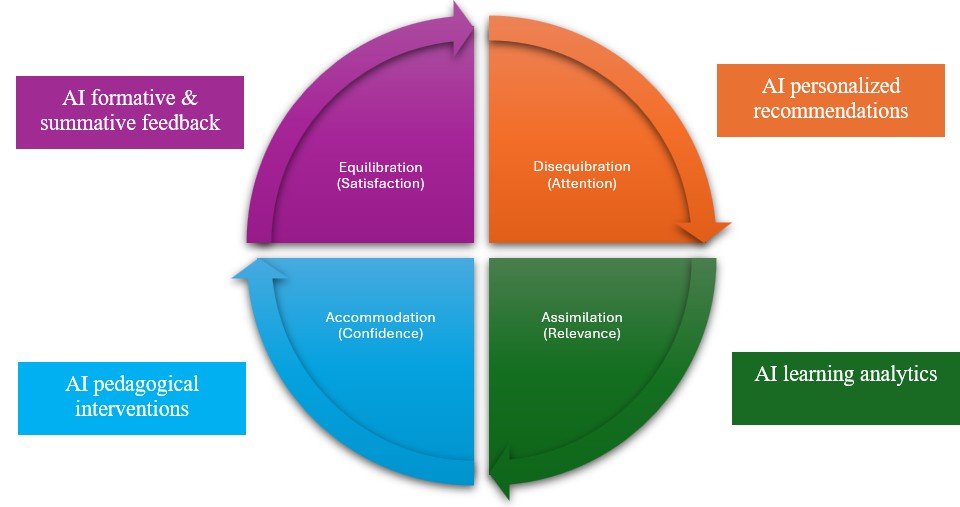
Gibson and Ifenthaler (2024) claim that AI grounded in this model promotes individual learning, team productivity, and multidisciplinary knowledge building. This model is drawn from educational psychology, biology, instructional design, cognitive science, computer science, complexity and sociocultural theory, and includes a causal learning mechanism that explains how learning occurs and works across micro, meso, and macro levels. As explained by Gibson and Ifenthaler (2024) and Gibson et al. (2023), the meso-level involves the learning processes of team members, while the macro-level concerns the learning processes of groups of groups in the context of sociocultural evolution. Given the scope of research on individual learning with NLP, this paper considers only the micro-level of learning, as illustrated in Figure 1.
Figure 1
Individual Learning Cycle at the Micro Level
Note. This figure was modified from “Learning theories for artificial intelligence promoting learning processes,” by Gibson et al., 2023, British Journal of Educational Technology, 54, p. 1131 (https://doi.org/10.1111/bjet.13341). CC BY-NC 4.0.
The micro-level (individual learning) includes Piaget’s (1985) cognitive equilibration theory, Kauffman’s (2000) autocatalytic agency, and Song and Keller’s (1999) ARCS model of motivation (Gibson & Ifenthaler, 2024; Gibson et al., 2023). Individual learners collaborate with AI, progressing through the four stages of micro-level learning, as illustrated in Figure 1. When learners encounter new information, they enter a state of disequilibrium. They search for the root cause with attention, and AI recommendation systems provide personalized content according to the needs of learners. When learners engage with new information in a meaningful context, learning analytics provides personalized insights into their performance by highlighting their current progress. Pedagogical interventions are applied to promote higher-order thinking skills during the accommodation stage. Formative and summative feedback allows learners to develop new knowledge and skills, achieving the equilibration phase. Learners progress through recurring phases of learning on their lifelong journey. AI serves as a collaborator for individual learners, enhancing their learning outcomes.
Nieminen et al. (2022) underscore the importance of critically evaluating theories and research studies to promote a robust, reflective, and ethically grounded discipline. Given that the three-level model was recently proposed as a learning theory by Gibson et al. (2023), assessing its validity using established criteria is imperative. A validated new framework empowers instructional designers to advance education by anchoring their practice in a credible learning theory. Furthermore, such a framework provides a reliable foundation for effective implementation. This paper uses Patterson’s eight criteria to evaluate the three-level model as a learning theory (Lincoln & Lynham, 2011).
Patterson (1986, as cited in Lincoln & Lynham, 2011) proposes eight criteria for evaluating the soundness of a theory in applied disciplines. These criteria include importance, precision and clarity, parsimony and simplicity, comprehensiveness, operationality, empirical validation or verification, fruitfulness, and practicality. Patterson’s eight criteria assess whether the three-level model is valuable and applicable to practices in distance education. Table 1 presents the detailed assessment.
Table 1
Assessment of Gibson et al.’s 3-level model| Criterion | Assessment |
|---|---|
| Importance | Synthesizes and unifies existing theories; proposed to enhance computational modelling and extend AI’s educational role |
| Precision and Clarity | Understandable and consistent within and across micro, meso, and macro levels |
| Parsimony and simplicity | Scalable and straightforward across the three levels of learning |
| Comprehensiveness | Combines existing theories from educational psychology, biology, and computer science |
| Operationality | Clearly articulated for Instructional designers to evaluate propositions and determine contextual relevance |
| Empirical validation or verification | Supported by Piaget (1985), Kauffman (2000), Song & Keller (1999), Donovan et al. (1999), Garrison et al. (1999), and Engeström (1999) |
| Fruitfulness | Provides valuable insights into AI’s role in learning and directions for future research |
| Practicality | Offers a conceptual framework useful for instructional designers in distance education contexts |
As discussed above, the three-level model supports the integration of NLP into instructional design. This model enhances computational modelling and facilitates the analysis of the roles of AI in education across micro, meso, and macro levels. Its multidisciplinary foundation, operational clarity, and scalability make it particularly relevant for distance education.
NLP is defined as “an area of research and application that explores how computers can be used to understand and manipulate natural language text or speech to do useful things” (Chowdhury, 2003). NLP analyzes, understands, and generates human language, thereby enhancing the learning experience through interactive and adaptive educational technologies.
NLP for enhancing learning encompasses machine translation, automatic summarization, text and course classification, sentiment analysis, voice recognition, chatbots, question-answering systems, and recommendation systems (Kaouni et al., 2023; Kökver et al., 2025). Machine translation leverages the advancements in NLP to analyze and process natural language text. Automatic summarization is achieved by understanding the text’s meaning and extracting the most relevant information from it. Text/Course classification involves assigning a document to one or more classes based on content. Sentiment analysis (Wankhade et al., 2022) extracts subjective information from a raw textual dataset. Voice recognition (Rabiner, 1989) analyzes human speech and converts it into text. Chatbots/Question answering systems understand and answer learners’ inquiries. The recommendation system (Roy & Dutta, 2022) provides learners with personalized suggestions and tailored content by analyzing their data and behaviors.
The definition of technology is crucial to instructional design, as it informs the effective application and integration of technology into LMSs (Bates, 2022). According to the online Cambridge Dictionary (n.d.), technology is the “use of scientific discoveries for practical purposes, especially in industry.” Etymonline (n.d.) defines technology:
1610s, a discourse or treatise on an art or the arts. from Latinized form of Greek tekhnologia systematic treatment of an art, craft, or technique, originally referring to grammar, from tekhno-, combining form of tekhnē art, skill, craft in work; method, system, an art, a system or method of making or doing, from PIE *teks-na- craft (of weaving or fabricating), from suffixed form of root *teks- o weave, also to fabricate.
According to the online epistemology dictionary, technology refers to words or discourse about how knowledge is acquired. Wills (2021) posits that our modern conception of technology occurred barely a century ago. The meaning of technology has evolved to encompass digital advancements, such as software and artificial intelligence.
John McCarthy introduced the term artificial intelligence in 1956, proposing “every aspect of learning or any other feature of intelligence can in principle be so precisely described that a machine can be made to simulate it” (McCarthy et al., 2006). AI refers to “computers which perform cognitive tasks, usually associated with human minds, particularly learning and problem-solving” (Baker et al., 2019, p. 10). Baker et al. (2019) adopt an umbrella term to describe a range of technologies and methods, including machine learning, natural language processing, data mining, neural networks, and algorithms.
Bates (2022) defines media as having two meanings in terms of teaching and learning, as follows:
The word ‘medium’ comes from the Latin, meaning in the middle (a median) and also that which intermediates or interprets. Media require an active act of creation of content and /or communication, and someone who receives and understands the communication, as well as the technologies that carry the medium (p. 457).Media refers to “the various forms of communication designed to reach a broad audience” (National Geographic, n.d.). It encompasses traditional forms, such as newspapers, radio, and television, as well as digital platforms like the Internet and social media. The term “media” derives from the Latin word for “intermediary,” highlighting its role as a conduit for information from source to receiver.
Bates (2022) defines technology as “tools and machines that may be used to solve real-world problems” (p. 456). He points out that technologies or technological systems cannot communicate or create meaning. Because of this, he argues that embedding technology into the media is necessary. Bates (2022) classifies AI as a form of media (p. 459). However, this paper challenges that interpretation, claiming that it overlooks the communicative and meaning-making capabilities of NLP. As a technology that enables interaction with humans and facilitates the generation of meaning, NLP extends beyond the scope of media. Therefore, this paper classifies NLP as a technology rather than a form of media.
NLP offers several benefits to distance education. NLP analyzes, understands, and generates natural language to enhance learning performance, improve learning outcomes, and present personalized learning experiences (Alhawiti, 2014; Baranwal, 2022; Chang et al., 2023; Chiu et al., 2022; Kaouni et al., 2023; Katuka et al., 2024; Litman, 2016; Weng et al., 2024). Alhawiti (2014) highlights that NLP provides learners with linguistic tools, such as grammar, syntax, and textual patterns, to facilitate effective language learning.
According to Matellio (2023), NLP revolutionizes education by making learning more personalized, engaging, and efficient. By integrating technologies such as chatbots and virtual assistants, NLP significantly enhances learner engagement through interactive experiences. Additionally, NLP analyzes learner performance, delivers personalized feedback, enhances learning experiences, and improves reading comprehension. NLP helps learners refine their writing by providing formative and actionable feedback.
Chatbots are popular NLP technologies that support learning activities (Chang et al., 2023; Okonkwo & Ade-Ibijola, 2021). They are effective tools for facilitating learning within educational contexts (Adamopoulou & Moussiades, 2020; Chang et al., 2023; Kooli, 2023; Labadze et al., 2024; Okonkwo & Ade-Ibijola, 2021). Chatbots play an increasingly significant role in facilitating learner interaction. With the majority of higher education students owning smartphones and frequently using internet applications, chatbots can serve as learning aids (Okonkwo & Ade-Ibijola, 2021) .One of the key advantages of teachable agents (TAs) is their capacity to support and scaffold the learning process (Baranwal, 2022). TAs enhance learner engagement and foster self-regulation by guiding learners through tasks and promoting active involvement. By providing clear explanations and responding to queries, TAs help reduce cognitive load, enabling learners to focus on understanding without becoming overwhelmed. Furthermore, TAs provide personalized learning experiences by adapting to individual learner needs and proficiency levels, thereby contributing to improved learning outcomes through targeted support.
Chiu et al. (2022) highlight that NLP allows learners to have enhanced engagement and motivation, improved academic achievement, and increased creativity and problem-solving skills. They also indicate that NLP facilitates self-reflection and self-directed learning, while reducing dropout rates by proactively identifying at-risk learners and providing them with the necessary support. NLP in e-learning platforms offers personalized learning by analyzing learner data and presenting customized educational content (Kaouni et al., 2023). Integrating NLP into e-learning platforms facilitates inclusivity and enhances efficiency in distance education. According to Litman (2016), the benefits of NLP include enhanced assessment capabilities, personalized learning experiences, improved learner navigation, individualized tutoring support, and the facilitation of content creation.
Instructional designers should create real-life activities that meet learners’ expectations for high quality (Hayes, 2015, as cited in Crosslin et al., 2020). They should consider activities that nudge learners to engage in active learning. To keep learners engaged in their learning, instructional designers should provide a brief text-based response to discussion prompts (Crosslin et al., 2020). Embedding virtual assistants or chatbots into LMSs highlights the pedagogical affordances of NLP, offering learners enriched and interactive learning experiences (Bates, 2022). Although Bates (2022) views AI as a medium, he acknowledges the potential of NLP to enhance learning outcomes (p. 506). Bates (2022) emphasizes that practitioners should critically evaluate the pedagogical strengths and limitations of NLP, as these insights inform instructional designers of the importance of effectively managing its use.
NLP is integrated into LMSs through plugins or apps, enabling educational institutions to add NLP capabilities without extensive custom development (Canvas, n.d.; D2L, n.d.; Moodle, n.d.). Plugins and apps are modular tools that can be added directly to an LMS platform, enhancing functionality with minimal setup. These integrations can offer various NLP features, including automated grading, sentiment analysis, real-time feedback, and even virtual tutoring. Using plugins, LMSs can provide tailored educational support, including grammar correction, topic extraction, and personalized recommendations. This makes the learning experience more engaging and responsive to individual student needs. This approach also enables educational institutions to quickly adopt NLP functionalities while maintaining the integrity and compatibility of their LMS. According to Jhajj et al. (2023), LMSs integrated with NLP identify areas where learners are struggling or disengaged, thereby fostering a more supportive and effective LMS. This NLP-driven approach detects learner confusion in online discussions by analyzing linguistic cues in forum posts and presents personalized support accordingly.
Moodle (n.d.) hosts a plugin directory featuring 460 plugins. Moodle (2023) leverages AI through Moodle plugins, including AI Connector, AI Text-to-Questions Generator, OpenAI Chat Block, AI Text-to-Image repository, and Summary. AI Connector provides access to ChatGPT, DALL-E, and Stable Diffusion plugins. AI Text-to-Questions Generator creates questions from a given text using OpenAI ChatGPT. Teaching Assistant Block, as an OpenAI-powered Teaching Assistant chatbot, understands the content. AI Text to Image is a repository that integrates AI-generated images into Moodle using the OpenAI API. Summary called Ask4Summary generates summaries based on the similarity of a part of speech to the question.
Canvas (n.d.) offers external apps, which provide simple ways to add new features to Canvas. External apps can be linked to individual or all courses within an account. Bamboo Learning leverages voice recognition technology and conversational AI, ReadSpeaker offers text-to-speech (TTS) with many built-in accessibility tools, Cerego (n.d.) is a personalized learning platform that helps people learn faster, remember longer, and quantify their knowledge, and Zapier Chatbot enables integration with Canvas through iframes.
D2L Brightspace Integration Directory (n.d.) is a feature of the Brightspace LMS that enables integration with various third-party tools, applications, and data systems. It enhances the LMS’s functionality to support learners. IntegrationHub (D2L Brightspace Integration Directory, n.d.) is a central platform that allows institutions to connect Brightspace with educational technologies through Learning Tools Interoperability (LTI), xAPI, and various API protocols, making it adaptable to diverse educational needs. ReadSpeaker integrates features to read HTML content aloud, highlighting spoken text and online documents in various formats. ReadSpeaker TextAid is designed for struggling readers and language learners as an LTI tool. StudyFetch allows learners to upload various study materials (PDFs, PPTXs, and MP4s) and, in turn, receive AI-generated flashcards, practice tests, and study guides.
Integrating NLP into instructional design presents several challenges that must be addressed to ensure effective implementation. First, ethical issues are related to data collection, use, and ownership (Kaouni et al., 2023; Kumar et al., 2024; UNESCO, 2019b; Zawacki-Ricker et al., 2019). These concerns include questions of data privacy, transparency of algorithmic recommendations, and the concentration of data within proprietary systems. Furthermore, questions arise about who owns the data and the algorithms developed from that data, which raises additional concerns regarding transparency and responsible governance in NLP-driven learning environments.
Second, it could worsen the digital divide (UNESCO, 2019b, 2021). According to UNESCO (2025), a quarter of primary schools worldwide lack electricity, while only half of lower secondary schools have internet access. Yan et al. (2024) assert that NLP contributes to the emergence of a two-tiered education system, wherein affluent learners benefit from personalized, dynamic, and interactive learning experiences, while less privileged learners are limited to static, one-size-fits-all instructional content. This disparity raises critical concerns about educational equity, deteriorates the existing digital divide, and underscores issues of inequality in access to quality education (Chan & Tsi, 2023).Third, overreliance on NLP has been shown to negatively influence learners’ cognitive abilities, including critical thinking skills, problem-solving, and decision-making (Misiejuk et al., 2025; Zhai et al., 2024). Zhai et al. (2024) emphasize that an overreliance on AI-generated content may impede the development of analytical reasoning skills. This behaviour is further reinforced by cognitive biases and heuristic processing, where learners prefer quick, seemingly optimal responses generated by NLP over deeper, reflective, and evidence-based reasoning. Chan and Tsi (2023) argue that NLP has a negative impact on learners’ cognitive and holistic development, hindering their creativity, critical thinking skills, and mental development.
Fourth, learners can potentially engage in plagiarism, which refers to using others’ work without proper attribution (Dehouche, 2021; Dergaa et al., 2023; Kumar et al., 2024; Sarles, 2025; UNESCO, 2023). In such cases, learners might view the chatbot as doing the cognitive work for them, but it is considered plagiarism when learners produce their work without proper citation (Dehouche, 2021; Dergaa et al., 2023; Grassini, 2023; Kumar et al., 2024; Sarles, 2025; UNESCO, 2023).
Lastly, NLP outputs cannot be trusted to be accurate because they are generated using “statistical patterns to predict likely words or phrases that might form a coherent response to the prompt” (UNESCO, 2023, p. 9). NLP is not fully reliable because it produces things, people, or places that do not exist, called hallucinations (OpenAI, 2023, 2025; UNESCO, 2023; Zhai et al., 2024). However, NLP’s plausible output can mislead learners without notice, containing false information (UNESCO, 2023; Zhai et al., 2024).
To effectively address the challenges of NLP, a range of strategic interventions should be implemented. First and foremost, educational institutions should establish robust AI governance frameworks that prioritize data privacy, transparency, and ethical integrity (Ally & Mishra, 2024a, 2024b; Chan, 2023; UNESCO, 2019b, 2021). These frameworks should be adaptive and evidence-informed, incorporating pilot testing, ongoing monitoring, and systematic evaluation to ensure continuous improvement and contextual relevance (UNESCO, 2021). The use of NLP in educational data should be protected and utilized through the transparent and auditable application of NLP, while striking a balance between open access and data privacy (UNESCO, 2019a). In alignment with these concerns, Prinsloo (2017) advocates an ethics of care in examining the implications of algorithmic decision-making within NLP systems, highlighting moral and fiduciary duty.
Moreover, it is crucial to ensure equitable access to NLP applications to foster an inclusive learning environment (Chan, 2023; UNESCO, 2019a). Such accessibility supports fairness in education and promotes inclusivity. UNESCO (2019a) emphasizes that everyone, regardless of gender, disability, or socio-economic background, can access NLP to achieve Sustainable Development Goal 4 (SDG 4) – Education 2030 (United Nations, 2015). It also asserts that the use of NLP in education must not exacerbate the digital divide or exhibit bias against vulnerable groups.
Lastly, both learners and educators must possess AI literacy to effectively and appropriately use NLP (Chan, 2023; Kumar et al., 2024; UNESCO, 2019a, 2023, 2024a, 2024b). Understanding NLP concepts, the benefits and risks of NLP, and the effective use of NLP are essential for empowering learners and educators to fully harness its affordances (Chan, 2023; Kumar et al., 2024; UNESCO, 2019a) and to mitigate the challenges of plagiarism (Dehouche, 2021; Dergaa et al., 2023; Grassini, 2023; Kumar et al., 2024; Sarles, 2025; UNESCO, 2023) and hallucination (OpenAI, 2023, 2025; UNESCO, 2023; Zhai et al., 2024).
The use of NLP should be humanistic, protecting human rights and equipping all learners with skills for effective learner-NLP collaboration in learning and life, thereby promoting sustainable development (UNESCO, 2019a, 2023, 2024a, 2024b).
This study concludes that integrating NLP into instructional design can significantly enhance distance education by offering personalized, interactive, and learner-centred experiences. The three-level model, proposed as a new framework, supports AI-assisted learning, particularly in learning processes. However, while the model is theoretically robust, its applicability remains limited to learning processes. To fully harness the potential of NLP, instructional designers must strike a balance between technological affordances and ethical considerations, including data privacy and accessibility.
Future research can empirically examine the effectiveness of the three-level model in real-world educational settings. Such research would help validate the model, refine NLP integration strategies, and ensure equitable, secure, and pedagogically sound implementation of NLP technologies in education. Moreover, future research can empirically investigate how AI literacy influences judicious NLP use and which instructional design elements foster critical thinking for the appropriate use of NLP outputs.
Adamopoulou, E., & Moussiades, L. (2020). An overview of chatbot technology. In I. Maglogiannis, L. Iliadis, & E. Pimenidis (Eds.), Artificial intelligence applications and innovations (Vol 584, pp. 373-383). Advances in Information and Communication Technology. Springer, Cham. https://doi.org/10.1007/978-3-030-49186-4_31
Alhawiti, K.M. (2014). Natural language processing and its use in education. International Journal of Advanced Computer Science and Applications, 5(12), 72-76. https://dx.doi.org/10.14569/IJACSA.2014.051210
Ally, M., & Mishra, S. (2024a). Developing policy guidelines for artificial intelligence in post- secondary institutions. Commonwealth of Learning. http://hdl.handle.net/11599/5615
Ally, M., & Mishra, S. (2024b). Policies for artificial intelligence in higher education: A call for action. Canadian Journal of Learning and Technology, 50(3). https://cjlt.ca/index.php/cjlt/article/view/28869/21191
Azhar, M. H., Wibawa, B., & Siregar, E. (2024). Integrating instructional design for artificial intelligence based learning: A literature review. Proceedings of the 7th International Conference on Learning Innovation and Quality Education (ICLIQE 2023) (pp. 94–104). Atlantis Press. https://doi.org/10.2991/978-2-38476-301-6_11
Baker, T., Smith, L., & Anissa, N. (2019). Educ-AI-Tion Rebooted? Exploring the Future of Artificial Intelligence in Schools and Colleges. Nesta. https://www.nesta.org.uk/report/education-rebooted/
Baranwal, D. (2022). A systematic review of exploring the potential of teachable agents in English learning. Pedagogical Research, 7(1), em0117. https://doi.org/10.29333/pr/11553
Bates, A. W. (2022). The nature of knowledge and the implications for teaching. In Teaching in a digital age: Guidelines for designing teaching and learning (3rd ed., pp. 97-148). Tony Bates Associates Ltd. https://pressbooks.bccampus.ca/teachinginadigitalagev3m/
Bozkurt, A., & Sharma, R. C. (2023). Challenging the status quo and exploring the new boundaries in the age of algorithms: Reimagining the role of generative AI in distance education and online learning. Asian Journal of Distance Education, 18(1). https://www.asianjde.com/ojs/index.php/AsianJDE/article/view/714
Cambridge Dictionary. (n.d.). Technology. https://dictionary.cambridge.org/dictionary/english/technology
Canvas. (n.d.). What is Canvas? https://community.canvaslms.com/t5/Canvas-Basics-Guide/What-is-Canvas/ta-p/45
Cerego. (n.d.). Education solutions. https://www.cerego.com/solutions/education
Chan, C. K. Y. (2023). A comprehensive AI policy education framework for university teaching and learning. International Journal of Educational Technology in Higher Education, 20, 38. https://doi.org/10.1186/s41239-023-00408-3
Chan, C. K. Y., & Tsi, L. H. Y. (2023). The AI revolution in education: Will AI replace or assist teachers in higher education? ArXiv, abs/2305.01185. https://doi.org/10.48550/arXiv.2305.01185
Chang, D. H., Lin, M. P.-C., Hajian, S., & Wang, Q. Q. (2023). Educational design principles of using AI chatbot that supports self-regulated learning in education: Goal setting, feedback, and personalization. Sustainability, 15(17), 12921. https://doi.org/10.3390/su151712921
Chen, X., Xie, H., Zou, D., & Hwang, G.-J. (2020). Application and theory gaps during the rise of artificial intelligence in education. Computers and Education: Artificial Intelligence, 1, 100002. https://doi.org/10.1016/j.caeai.2020.100002
Chiu, T.K.F., Xia, Q., Zhou, X., Chai, C.S., & Cheng, M. (2022). Systematic literature review on opportunities, challenges, and future research recommendations of artificial intelligence in education. Computers and Education: Artificial Intelligence, 4, 100118. https://doi.org/10.1016/j.caeai.2022.100118
Chowdhury, G. G. (2003). Natural language processing. Annual Review of Information Science and Technology, 37(1), 51-89. https://doi.org/10.1002/aris.1440370103
Crosslin, M., Benham, B., Dellinger, J., Patterson, A., Semingson, P., Spann, C., Usman, B., & Watkins, H. (2020). Creating Online Learning Experiences. Mavs Open Press. https://uta.pressbooks.pub/onlinelearning/
Dehouche, N. (2021). Plagiarism in the age of massive generative pre-trained transformers (GPT-3). Ethics in Science and Environmental Politics, 21(1), 17–23. https://doi.org/10.3354/esep00195
Dergaa, I., Chamari, K., Zmijewski, P., & Saad, H. B. (2023). From human writing to artificial intelligence generated text: Examining the prospects and potential threats of ChatGPT in academic writing. Biology of Sport, 40(2), 615-622. https://doi.org/10.5114/biolsport.2023.125623
Donovan, S., Bransford, J., & Pellegrino, J. (1999). In National Research Council (Ed.), How people learn: Bridging research and practice. National Academy Press. https://nap.nationalacademies.org/catalog/9457/how-people-learn-bridging-research-and-practice
D2L. (n.d.). D2L Brightspace – Learning Management Platform. https://www.d2l.com/brightspace/
D2L Brightspace Integration Directory. (n.d.). Integrationhub. https://integrationhub.brightspace.com/
Engeström, Y. (1999). Activity theory and individual and social transformation. In Y. Engeström, R. Miettinen & R. Punamaki (Eds.), Perspectives on activity theory (pp. 19–38). Cambridge University Press.
Etymonline. (n.d.). Technology. https://www.etymonline.com/search?q=technology&utm_campaign= sd&utm_medium=serp&utm_source=ds_search
Garrison, D. R., Anderson, T., & Archer, W. (1999). Critical inquiry in a text-based environment: Computer conferencing in higher education. The Internet and Higher Education, 2(2– 3), 87– 105. https://doi.org/10.1016/S1096-7516(00)00016-6
Gibson, D. C., & Ifenthaler, D. (2024). Computational learning theories: Models for artificial intelligence promoting learning processes. Springer. https://doi.org/10.1007/978-3-031-65898-3
Gibson, D., Kovanovic, V., Ifenthaler, D., Dexter, S., & Feng, S. (2023). Learning theories for artificial intelligence promoting learning processes. British Journal of Educational, 54, 1125-1146. https://doi.org/10.1111/bjet.13341
Grassini, S. (2023). Shaping the future of education: Exploring the potential and consequences of AI and ChatGPT in educational settings. Education Sciences, 13(7), 692. https://doi.org/10.3390/educsci13070692
Hew, K. F., Lan, M., Tang, Y., Jia, C., & Lo, C. K. (2019). Where is the “theory” within the field of educational technology research? British Journal of Educational Technology, 50(3), 956–971. https://doi.org/10.1111/bjet.12770
Hwang, G. J., Xie, H., Wah, B. W., & Gašević, D. (2020). Vision, challenges, roles and research issues of Artificial Intelligence in education. Computers and Education: Artificial Intelligence, 1, 100001. https://doi.org/10.1016/j.caeai.2020.100001
Jhajj, G., Dewan, M. A. A., & Lin, F. (2023). Unveiling uncertainty: Supporting learners through NLP-driven confusion identification. 2023 IEEE Intl Conf on Dependable, Autonomic and Secure Computing, Intl Conf on Pervasive Intelligence and Computing, Intl Conf on Cloud and Big Data Computing, Intl Conf on Cyber Science and Technology Congress (DASC/PiCom/CBDCom/CyberSciTech), 137–142. https://doi.org/10.1109/DASC/PiCom/CBDCom/Cy59711.2023.10361304
Kaouni, M., Lakrami, F., & Labouidya, O. (2023). Integrating artificial intelligence and natural language processing in e-learning platforms: A review of opportunities and limitations. 2023 7th IEEE Congress on Information Science and Technology (CiSt), Morocco, 56-63. https://doi.org/10.1109/CiSt56084.2023.10409971
Karagiorgi, Y., & Symeou, L. (2005). Translating constructivism into instructional design: Potential and limitations. Educational Technology & Society, 8(1), 17-27. https://www.jstor.org/stable/jeductechsoci.8.1.17
Katuka, G.A., Chakraburty, S., Lee, H., Dhama, S., Earle-Randell, T., Celepkolu, M., Boyer, K. E., Glazewski, K., Hmelo-Silver, C., & McKlin, T. (2024). Integrating natural language processing in middle school science classrooms: An experience report. Proceedings of the 55th ACM Technical Symposium on Computer Science Education (SIGCSE). USA. 639 – 645. https://doi.org/10.1145/3626252.3630881
Kauffman, S. (2000). Investigations. Oxford University Press.
Kökver, Y., Pektaş, H. M., & Çelik, H. (2025). Artificial intelligence applications in education: Natural language processing in detecting misconceptions. Education and Information Technologies, 30, 3035–3066. https://doi.org/10.1007/s10639-024-12919-1
Kooli, C. (2023). Chatbots in education and research: A critical examination of ethical implications and solutions. Sustainability, 15(7), 5614. https://doi.org/10.3390/su15075614
Kumar, S., Gunn, A., Rose, R., Pollard, R., Johnson, M., & Ritzhaupt, A. (2024). The role of instructional designers in the integration of generative artificial intelligence in online and blended learning in higher education. Online Learning, 28(3). https://doi.org/10.24059/olj.v28i3.4501
Labadze, L., Grigolia, M., & Machaidze, L. (2024). Correction: Role of AI chatbots in education: Systematic literature review. International Journal of Educational Technology in Higher Education, 21, 28. https://doi.org/10.1186/s41239-024-00461-6
Lincoln, Y. S., & Lynham, S. A. (2011). Criteria for assessing theory in human resource development from an interpretive perspective. Human Resource Development International, 14(1), 3–22. https://doi.org/10.1080/13678868.2011.542895
Litman, D. (2016). Natural language processing for enhancing teaching and learning. Proceedings of the AAAI Conference on Artificial Intelligence, 30(1). https://doi.org/10.1609/aaai.v30i1.9879
Matellio. (2023, February 17). How NLP in education sector can enhance learning experience? https://www.matellio.com/blog/nlp-in-education/
McCarthy, J., Minsky, M. L., Rochester, N., & Shannon, C. E. (2006). A Proposal for the Dartmouth summer research project on artificial intelligence, August 31, 1955. AI Magazine, 27(4), 12. https://doi.org/10.1609/aimag.v27i4.1904
McGuire, A., Qureshi, W., & Saad, M. (2024). A constructivist model for leveraging GenAI tools for individualized, peer-simulated feedback on student writing. International Journal of Technology in Education (IJTE), 7(2), 326-352. https://doi.org/10.46328/ijte.639
Misiejuk, K., López Pernas, S., Kaliisa, R., & Saqr, M. (2025). Mapping the landscape of generative artificial intelligence in learning analytics: A systematic literature review. Journal of Learning Analytics, 12(1), 12–31. https://doi.org/10.18608/jla.2025.8591
Moodle. (n.d.). Moodle Plugin Directory. https://moodle.org/plugins/?q=
Moodle. (2023, September 8). The potential of AI and Moodle. https://moodle.com/news/the-potential-of-ai-and-moodle/
National Geographic. (n.d.). Media. https://education.nationalgeographic.org/resource/media/
Nieminen, J. H., Bearman, M., & Tai, J. (2022). How is theory used in assessment and feedback research? A critical review. Assessment & Evaluation in Higher Education, 48(1), 77–94. https://doi.org/10.1080/02602938.2022.2047154
Okonkwo, C., & Ade-Ibijola, A. (2021). Chatbots applications in education: A systematic review. Computers and Education: Artificial Intelligence. 2, 100033. https://doi.org/10.1016/j.caeai.2021.100033
OpenAI. (2023, March 14). GPT-4. https://openai.com/index/gpt-4-research/
OpenAI. (2025, August 7). Introducing GPT-5. https://openai.com/index/introducing-gpt-5/
Piaget, J. (1985). The equilibration of cognitive structures: The central problem of intellectual development. University of Chicago Press.
Prinsloo, P. (2017). Fleeing from Frankenstein’s monster and meeting Kafka on the way: Algorithmic decision-making in higher education. E-Learning and Digital Media, 14(3), 138-163. https://doi.org/10.1177/2042753017731355
Rabiner, L. R. (1989). A tutorial on hidden Markov models and selected applications in speech recognition. Proceedings of the IEEE, 77(2), 257–286. https://doi.org/10.1109/5.18626
Roy, D., & Dutta, M. A. (2022). Systematic review and research perspective on recommender systems. Journal of Big Data, 9, 59. https://doi.org/10.1186/s40537-022-00592-5
Sarles, P. (2025). AIGIARISM: Reframing our understanding of plagiarism in the age of AI. Computers in Libraries, 45(6). https://link.gale.com/apps/doc/A846354589/AONE?u=anon~4ca6dd7&sid=sitemap&xid=7b0228f2
Schunk, D. H. (2012). Learning theories: An educational perspective (6th ed.). Pearson Education Inc.
Song, S., & Keller, J. (1999). The ARCS model for developing motivationally-adaptive computer-assisted instruction. National Convention of the Association for Educational Communication and Technology.
Sulindra, E, Cendra, A. N., & Hartani, T. (2024). Utilization of instructional technology in English language teaching (ELT) based on constructivism: A literature review. English Education and Literature Journal, 4(2). 141-153. https://doi.org/10.53863/ejou.v4i02.1150
UNESCO. (2019a). Beijing consensus on artificial intelligence and education. https://unesdoc.unesco.org/ark:/48223/pf0000368303
UNESCO. (2019b). Artificial Intelligence in education: Challenges and opportunities for sustainable development. https://unesdoc.unesco.org/ark:/48223/pf0000366994
UNESCO. (2021). AI and education: Guidance for policy-makers. https://www.unesco.org/en/articles/ai-and-education-guidance-policy-makers
UNESCO. (2023). Guidance for generative AI in education and research. https://doi.org/10.54675/EWZM9535
UNESCO. (2024a). AI competency framework for students. https://doi.org/10.54675/JKJB9835
UNESCO. (2024b). AI competency framework for teachers. https://doi.org/10.54675/ZJTE2084
UNESCO. (2025, January 20). Artificial intelligence in education: UNESCO advances key competencies for teachers and learners. https://www.unesco.org/en/articles/artificial-intelligence-education-unesco-advances-key-competencies-teachers-and-learners?utm_source=chatgpt.com
United Nations. (2015). Transforming our world: The 2030 agenda for sustainable development. https://sdgs.un.org/2030agenda
Wankhade, M., Rao, A. C. S., & Kulkarni, C. (2022). A survey on sentiment analysis methods, applications, and challenges. Artificial Intelligence Review, 55, 5731–5780. https://doi.org/10.1007/s10462-022-10144-1
Weng, X., Ye, H., Dai, Y., & Ng, Oi-Iam. (2024). Integrating artificial intelligence and computational thinking in educational contexts: A systematic review of instructional design and student learning outcomes. Journal of Educational Computing Research, 62(6), 1420-1450. https://doi.org/10.1177/07356331241248686
Wills, M. (2021, January 11). How technology got its modern meaning. JSTOR Daily. https://daily.jstor.org/how-technology-got-its-modern-meaning/
Yan, L., Martinez Maldonado, R., & Gasević, D. (2024, March 18-22). Generative artificial intelligence in learning analytics: Contextualising opportunities and challenges through the learning analytics cycle. Proceedings of the 14th Learning Analytics and Knowledge Conference (LAK 2024), Kyoto, Japan. https://doi.org/10.1145/3636555.3636856
Zawacki-Richter, O., Marín, V. I., Bond, M., & Gouverneur, F. (2019). A systematic review of research on artificial intelligence applications in higher education - where are the educators? International Journal of Educational Technology in Higher Education, 16(39). https://doi.org/10.1186/s41239-019-0171-0
Zhai, C., Wibowo, S., & Li, L. D. (2024). The effects of over‑reliance on AI dialogue systems on students’ cognitive abilities: A systematic review. Smart Learning Environments, 11, 28. https://doi.org/10.1186/s40561-024-00316-7