Teagan Gahler
Teagan Gahler is an instructor in the JR Shaw School of Business at the Northern Alberta Institute of Technology in Edmonton, Alberta, Canada. She holds a Master of Arts in Interdisciplinary Studies from Athabasca University and a Bachelor of Business Administration from the Northern Alberta Institute of Technology. She is currently pursuing a Doctor of Education at the University of Derby in Derby, United Kingdom. Her research interests focus on industry-academia collaboration, Boundary spanning leadership in higher education, applied business education, and enhancing student employability in polytechnic institutions. Teagan lives in Edmonton, Alberta and loves to spend time outside in the mountains outside of school and work.
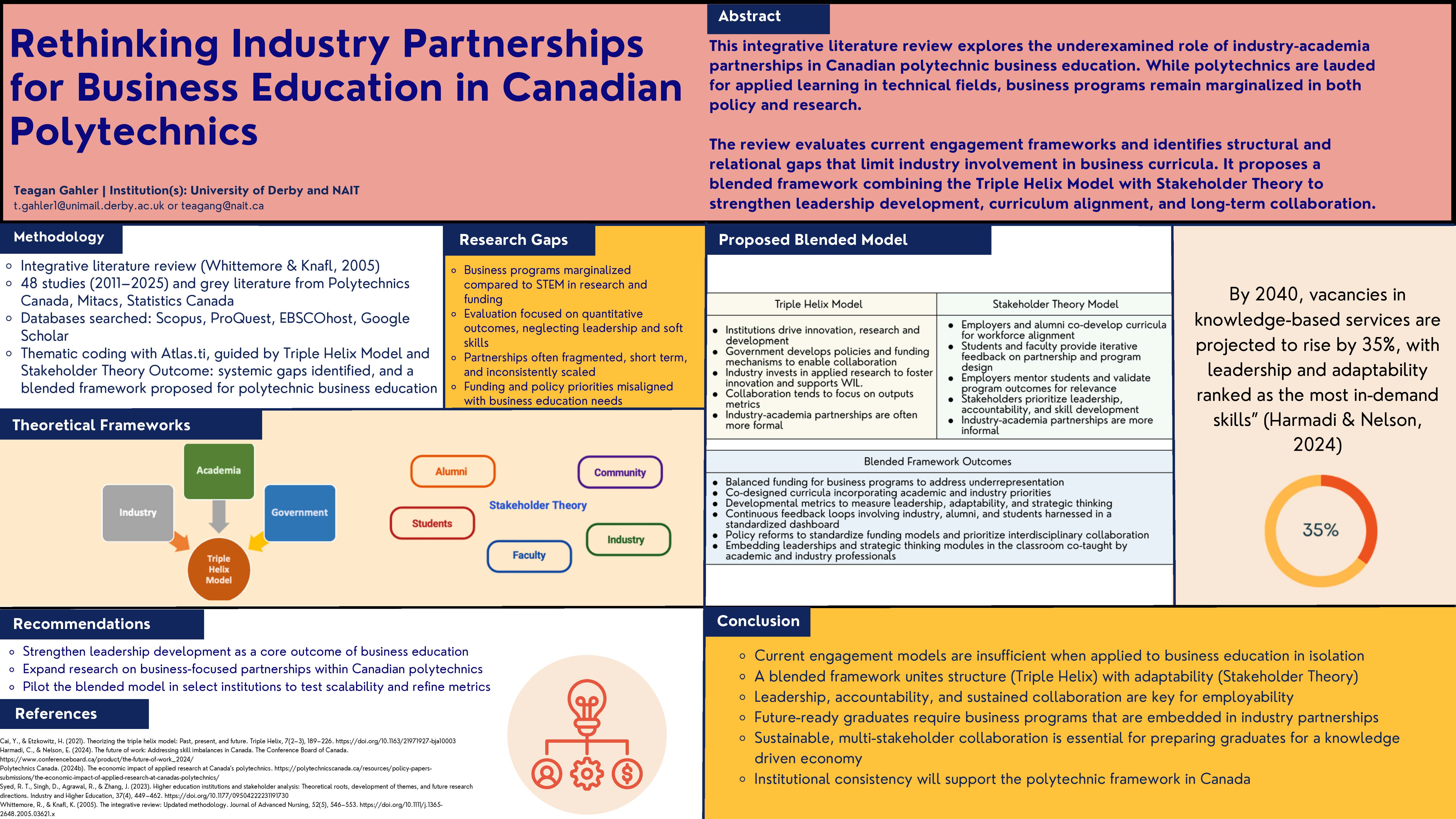
This poster explores the underexamined role of industry–academia partnerships in Canadian polytechnic business education. While polytechnics are widely recognized for applied learning in technical fields, business programs remain under-explored in both policy and research. The purpose of this poster is to evaluate existing engagement frameworks and identify structural and relational gaps that limit sustained industry involvement in business curricula. Peer-reviewed and grey literature were thematically analyzed using an integrative review methodology, guided by the Triple Helix Model and Stakeholder Theory. The findings indicate that current partnership frameworks are often fragmented, inconsistently scaled, and insufficiently attentive to leadership development and interdisciplinary business skills. As a result, business students face constrained opportunities for meaningful industry engagement and graduate with gaps in employability, adaptability, and leadership readiness. This poster proposes a blended framework that integrates the structural coordination of the Triple Helix with the relational flexibility of Stakeholder Theory to strengthen curriculum alignment, leadership development, and long-term collaboration. The framework highlights the need for more coherent funding models, scalable partnership strategies, and embedded stakeholder feedback mechanisms within business programs. As Canadian polytechnics respond to shifting labour market demands, this work contributes to broader discussions on strengthening industry–academic collaboration and graduate employability across higher education.
Keywords: Industry-academia partnerships, Canadian polytechnics, Business education, Leadership development, Engagement frameworks
Cai, Y., & Etzkowitz, H. (2021). Theorizing the triple helix model: Past, present, and future. Triple Helix, 7(2–3), 189–226. https://doi.org/10.1163/21971927-bja10003
Harmadi, C., & Nelson, E. (2024). The future of work: Addressing skill imbalances in Canada. The Conference Board of Canada. https://www.conferenceboard.ca/product/the-future-of-work_2024/
Polytechnics Canada. (2024b). The economic impact of applied research at Canada’s polytechnics. https://polytechnicscanada.ca/resources/policy-papers-submissions/the-economic-impact-of-applied-research-at-canadas-polytechnics/
Syed, R. T., Singh, D., Agrawal, R., & Zhang, J. (2023). Higher education institutions and stakeholder analysis: Theoretical roots, development of themes, and future research directions. Industry and Higher Education, 38(3), 218-233. https://doi.org/10.1177/09504222231191730
Whittemore, R., & Knafl, K. (2005). The integrative review: Updated methodology. Journal of Advanced Nursing, 52(5), 546–553. https://doi.org/10.1111/j.1365-2648.2005.03621.x