Evelyn Ullyott-Hayes
Evelyn Ullyott-Hayes is a student in the Master of Arts in Interdisciplinary Studies program. She also works for the Canadian Museum of Nature in Ottawa as a collections technician working with the Government of Nunavut’s archaeology collection. Her research interests include museology, material culture and history. She is invested in studying what objects reveal about the past and what modern heritage practice reveals about the present.
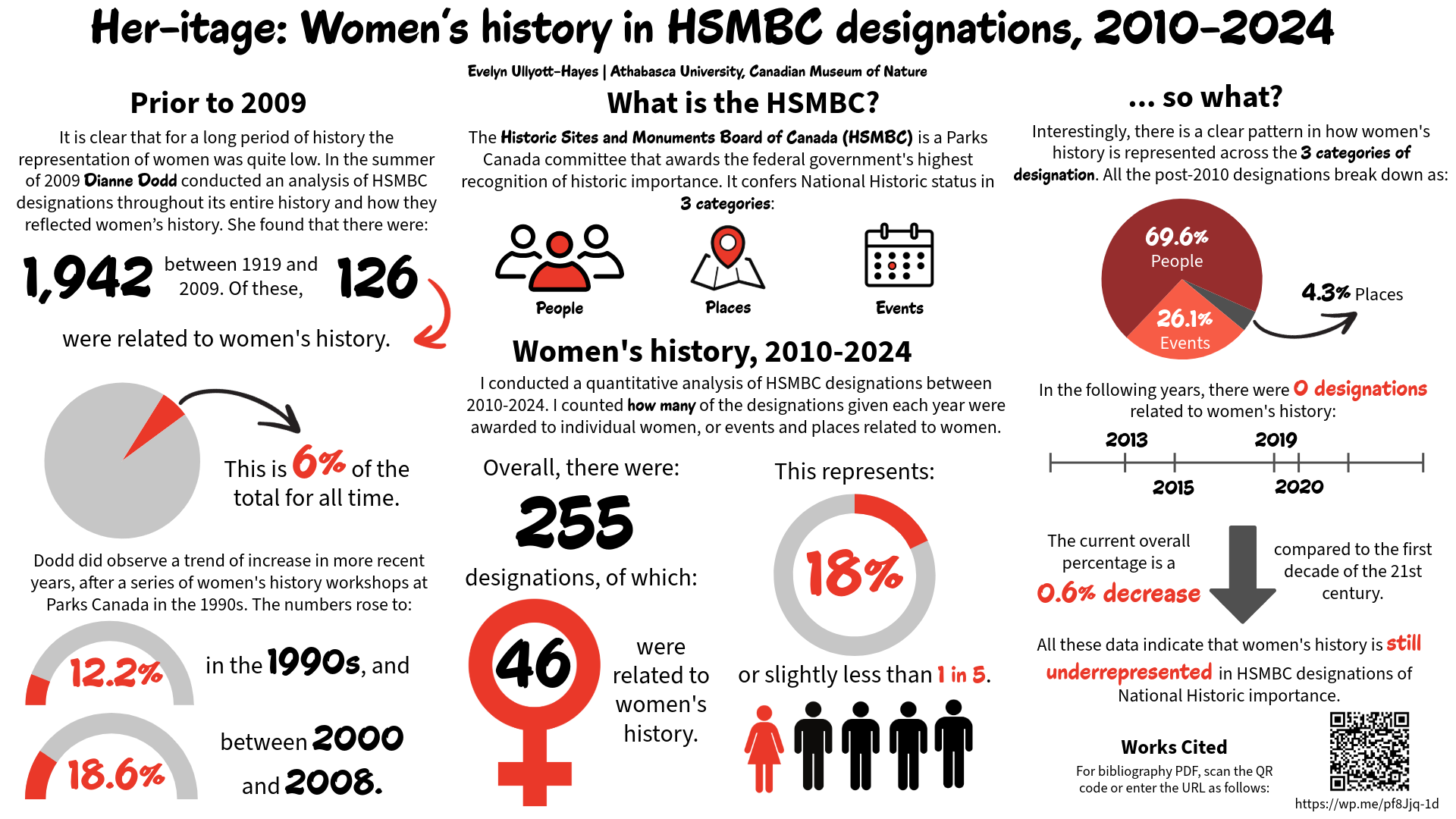
Over the course of its existence, women have undeniably made many noteworthy contributions to the history of Canada. This research investigates how these contributions are represented in governmental recognition of historical importance. Since their founding, historical regulatory bodies in Canada have used designations like National Historic status to create and perpetuate official narratives and ideals of Canada’s history as a settler colonial project. “Her-itage: a quantitative analysis of women’s history in Historic Sites and Monuments Board of Canada designations from 2010-2024” is an examination of how Parks Canada reflects this historical tendency, and whether women’s history has been considered of heritage significance by the federal government. It takes a mathematical approach to assessing how many officially recognized heritage resources (persons, sites and events) are relevant to women’s history and what percentage of designations as a whole they represent. In particular, it assesses these statistics for designations awarded after 2009 which is the last year for such information has been studied. The data show that the percentage of designations related to women’s history since 2009 is 0.6% lower than the percentage for 2000-2009 and thus that there has been no increase in this millennium. Furthermore, women are significantly more likely to be recognized as historic persons than sites or events in women’s history are to be designated. These results indicate that women’s history and contributions to Canadian history are still underrepresented at least in official assessments of heritage value.
Keywords: history, women’s history, heritage resources, Parks Canada, historic sites, heritage designations
Affleck, A. (2023, June 22). Heritage on the hotseat. National Trust for Canada. https://nationaltrustcanada.ca/online-stories/heritage-on-the-hotseat
Dodd, D. (2020). Women’s history at parks Canada. Canadian Historical Association, 31(1), 24-25. https://depot.erudit.org/dspace/bitstream/005084dd/1/9.Women%e2%80%99s%20history%20at%20parks%20canada%2031.1.pdf
Government of Alberta. (n.d.). Designation of provincial historic resources. Heritage Conservation and Protection. https://www.alberta.ca/designation-provincial-historic-resources
Government of Canada. (n.d.). Directory of federal heritage designations. Parks Canada. https://www.pc.gc.ca/apps/DFHD/search-recherche_eng.aspx
Government of Canada. (2024, May 14). Framework for history and commemoration: National historic sites system plan 2019. Parks Canada. https://parks.canada.ca/lhn-nhs/cadre-framework/cadre-2019-framework
Government of Canada. (2024, June 10). Fostering an inclusive history: Many peoples, many stories. Parks Canada. https://parks.canada.ca/lhn-nhs/cadre-framework/commemoration-inclusive-commemoration
Government of Canada. (2024, June 10). Framework for history and commemoration. Parks Canada. https://parks.canada.ca/lhn-nhs/cadre-framework/%7E/link.aspx?_id=8188D5C880B34BED945A406486E2C35C&_z=z
Government of Canada. (2025, March 25). The historic sites and monuments board of Canada. Parks Canada. https://parks.canada.ca/culture/designation/commission-board
Government of Ontario. (2025, May 9). Designating heritage properties. Arts and Culture. https://www.ontario.ca/document/designating-heritage-properties
Pentland, CJ. (2021). Commemoration as reconciliation: Indigenous history and Canada’s heritage designation system. The IJournal: Student Journal of the Faculty of Information, 6(2). https://doi.org/10.33137/ijournal.v6i2.36456
Ricketts, S. (1996). Cultural selection and national identity: Establishing historic sites in a national framework, 1920-1939. The Public Historian, 18(3), 23–41. https://doi.org/10.2307/3379211
Taylor, C. J. (1983). Some early problems of the historic sites and monuments board of Canada. The Canadian Historical Review, 64(1), 3–24. https://muse.jhu.edu/article/571468