Paige Gibbings
Paige Gibbings is a Master of Nursing (Education) thesis student at Athabasca University in Alberta, Canada. She works as a Clinical Nurse Coordinator for the ovarian tumour program in gynecologic oncology at Princess Margaret Cancer Centre (University Health Network) in Toronto. Her research explores the expectations of Licensed Practical Nurse to Bachelor of Nursing bridging students prior to their final clinical practicum, with a focus on with attention to transition, mentorship, and readiness for independent practice. She lives in Toronto and, outside of academia and clinical practice, enjoys needlepoint design and taking walks with her miniature dachshund.
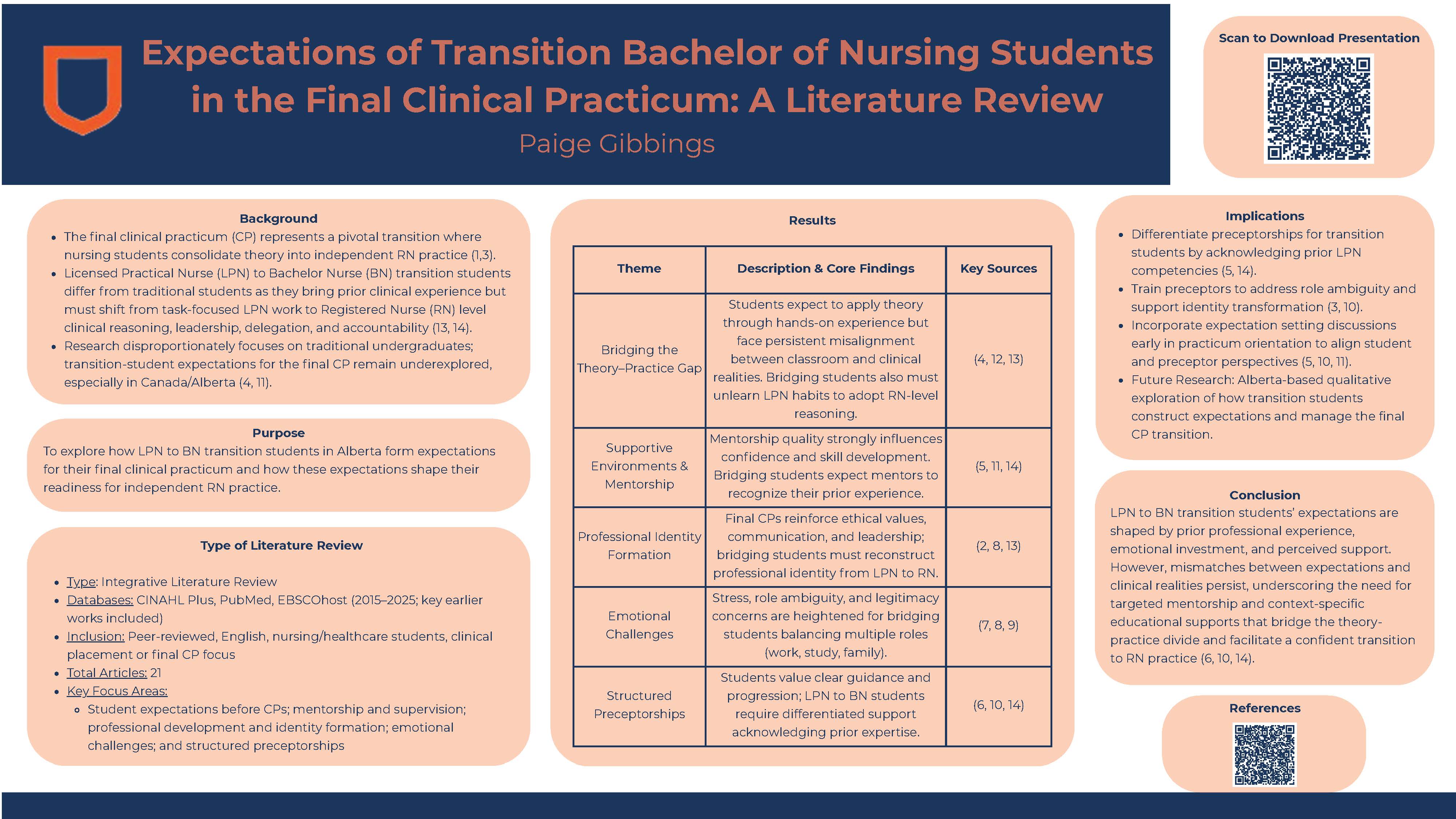
Background: The final clinical practicum (CP) is a pivotal transition for Licensed Practical Nurses (LPNs) in Bachelor of Nursing (BN) transition programs, preparing them for Registered Nurse (RN) practice. While research often addresses general CPs, little has focused on transition students who bring prior experience yet face unique challenges in their final CP.
Purpose: This review explores how transition students form expectations before their final CP and how these expectations shape their readiness for independent RN practice.
Type of Literature Review: An integrative review synthesizing findings from 21 peer-reviewed studies (2015–2025) and selected earlier works.
Results: Analysis of the literature revealed the following five themes shaping expectations. 1) Students predicted closing the theory–practice gap through hands-on application but faced misalignment with reality. 2) Supportive environments and mentorship acknowledging prior LPN experience were essential for RN development. 3) The CP was used to adapt established professional identities to RN responsibilities. 4) Emotional challenges were heightened by role ambiguity and competing demands. 5) Structured preceptorships were highly valued, though often limited by resources and inconsistent support.
Implications: This review highlights limited research on transition students’ expectations before the final CP in Canada. Addressing this gap requires examining how expectations are formed and how they shape the transition to RN practice.
Keywords: Professional transition, final clinical practicum, transition nurse students, bridging education, expectations, professional identity, mentorship, readiness
Canadian Association of Schools of Nursing (CASN). (2015). Practice domain for baccalaureate nursing education: Guidelines for clinical placements and simulation.https://www.casn.ca/wp-content/uploads/2015/11/Draft-clinical-sim-2015.pdf
Ciftci, B., Sirin Gok, M., Aksoy, M., & Avsar, G. (2020). The effect of internships on clinical decision making and professional values of nursing students. International Journal of Caring Sciences, 13(2), 1230–1239.
College of Registered Nurses of Alberta (CRNA). (2019). Entry-level competencies for the practice of registered nurses. https://cms.nurses.ab.ca/media/p4nel3mq/9-entry-level-competencies-for-the-practice-of-registered-nurses-mar-2019.pdf
Cowen, K. J., Hubbard, L. J., & Hancock, D. C. (2018). Expectations and experiences of nursing students in clinical courses: A descriptive study. Nurse Education Today, 67, 15– 20. https://doi.org/10.1016/j.nedt.2018.04.024
Elliott, B., Beck, J. A., & Buffenbarger, J. (2020). Learning transfer and transition of certified nursing assistants to baccalaureate nursing programs. Nursing Forum, 55(2), 197–204. https://doi.org/10.1111/nuf.12416
Foster, K., Ooms, A., & Marks-Maran, D. (2015). Nursing students’ expectations and experiences of mentorship. Nurse Education Today, 35(1), 18-24. https://doi.org/10.1016/j.nedt.2014.04.019
Hoag, D. K. (2016). The transition experiences of graduates of a synchronous online LPN to RN program [Doctoral dissertation, University of Phoenix].
Janzen, K., Melrose, S., Gordon, K., & Miller, J. (2013). "RN means real nurse": Perceptions of being a "real" nurse in a post-LPN-BN bridging program. Nursing Forum, 48, 165-173. https://doi.org/10.1111/nuf.12026
Marriott, P. H. M., Weller-Newton, J. M., & Reid, K. J. (2024). Preparedness for a first clinical placement in nursing: A descriptive qualitative study. BMC Nursing, 23, 345. https://doi.org/10.1186/s12912-024-01916-x
Mathew, R., Noronha, J. A., & Nayak, S. G. (2024). Exploring nursing students’ expectations on preceptoring and preceptorship program: A mixed method study. Journal of Caring Sciences, 13(2), 82-90.
Munangatire, T., Tomas, N., & Asino, H. M. M. (2023). Nursing students’ experiences and expectations of clinical learning: A qualitative study. Nurse Education Today, 124, 105758. https://doi.org/10.1016/j.nedt.2023.105758
Soler, O. M., Aguayo-González, M., San Rafael Gutiérrez, S., Jiménez Pera, M., & Leyva- Moral, J. M. (2021). Nursing students’ expectations of their first clinical placement: A qualitative study. Nurse Education Today, 98, 104736.https://doi.org/10.1016/j.nedt.2020.104736
Suva, G., Sager, S., Mina, E. S., Sinclair, N., Lloyd, M., Bajnok, I., & Xiao, S. (2015). Systematic review: Bridging the cap in RPN-to-RN transitions. Journal of Nursing Scholarship, 47(4), 363–370. https://doi.org/10.1111/jnu.12147
Tower, M., Cooke, M., Watson, B., Buys, N., & Wilson, K. (2015). Exploring the transition experiences of students entering into preregistration nursing degree programs with previous professional nursing qualifications: An integrative review. Journal of Clinical Nursing, 24(9-10), 1174–1188. https://doi.org/10.1111/jocn.12756