Eryn Aoife Leigh
Eryn is a busy solo parent wrapping up in the Master of Arts - Interdisciplinary Studies program. Their area of interest is the culture, community, and lived expertise of people living in encampments and other unsheltered settlements. Currently teaching at their local community college and working as a research assistant on multiple projects, Eryn brings both lived and frontline professional experience to their research and advocacy. They live simply in the woods with their two children, a teen and a toddler, and continue to learn from their unhoused friends and neighbours every day.
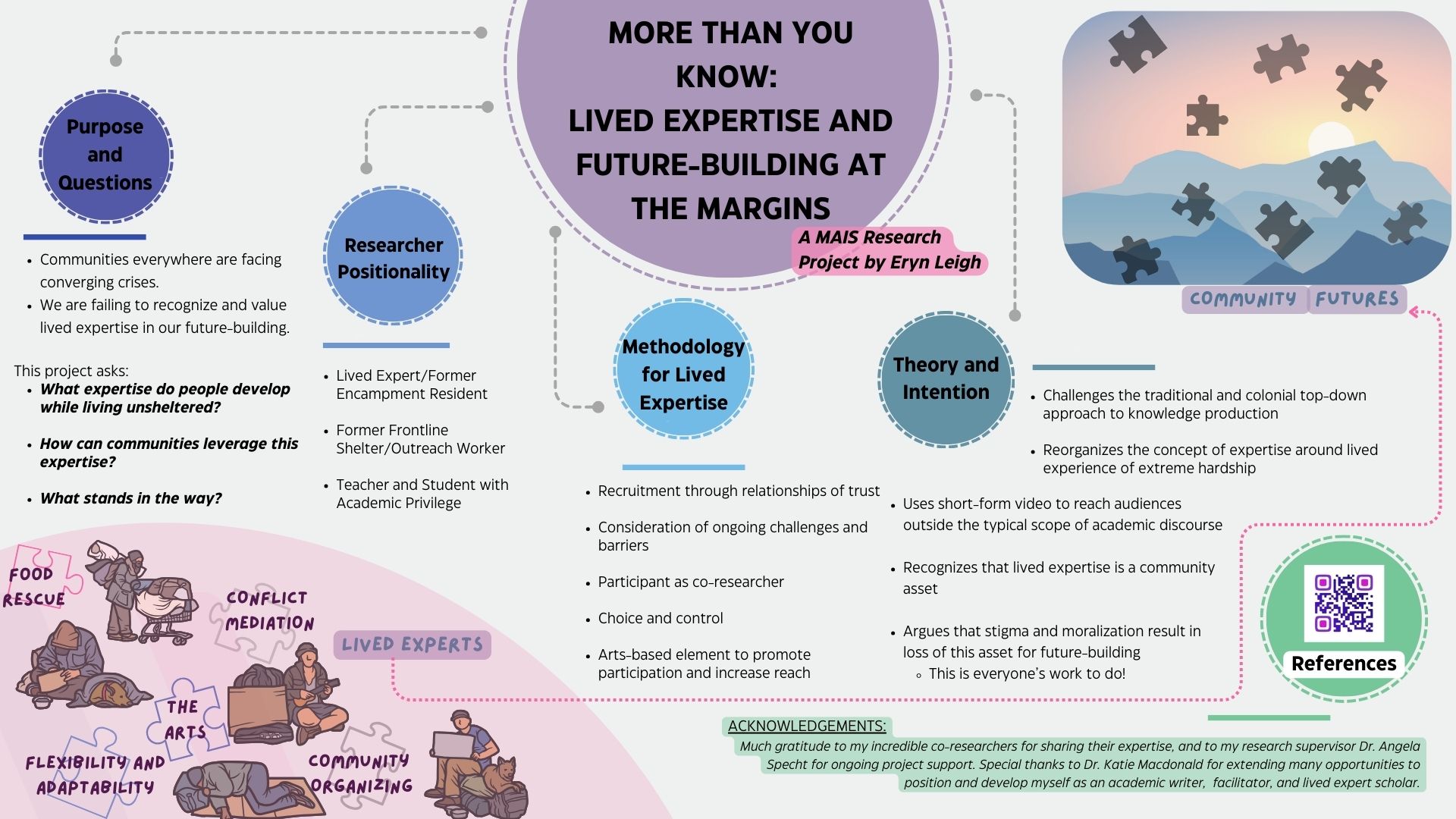
Unsheltered Canadians have weathered hardships and navigated crises that most of us could not imagine. In doing so, they have developed expertise in numerous areas such as housing, practical survival, resource sharing, conflict mediation, food security, and community leadership. The expert knowledge and skills acquired in encampments represent valuable assets to communities in a changing world, working to build resilient and sustainable futures. These community assets are denied to all of us by the ongoing stigma and moralization of people without housing. This study engaged several co-researchers who live or have lived in encampments. Using narrative analysis of semi-structured interviews, the project aimed to uncover the expertise people have developed in unsheltered settlements, as well as explore any opportunities for community growth and resilience that are missed through exclusion - or gained through inclusion - of these lived experts. Findings were artistically represented in video form, with guidance and direction of co-researchers. Positioning participants as co-researchers was a deliberate methodological choice to support a shift in thinking about expertise. This work employed a decolonizing approach, challenging the dominant settler colonial worldview which values and prioritizes expertise gained through formal training, higher education, or professional experience. Lived expert co-researchers had full control over how involved they wished to be in the research process, if and how they wished to be named or credited, and to what extent their work would be shared publicly. This poster highlights the project’s theoretical underpinning and its unique methodologies, crafted to honour and centre lived expertise.
Keywords: Housing, lived expertise, community, encampments, stigma
Alevizou, G., Alexiou, K., & Zamenopoulos, T. (2016). Making sense of assets: Community asset mapping and related approaches for cultivating capacities: A critical review of research and practice. The Open University and the AHRC. https://oro.open.ac.uk/47472/1/making-sense-of-assets.pdf
Archer, D., Marome, W., Natakun, B., Mabangyang, P., & Phanthuwongpakdee, N. (2019). The role of collective and individual assets in building urban community resilience. International Journal of Urban Sustainable Development, 12(2), 169-186. https://doi.org/10.1080/19463138.2019.1671425
Ardelt, M. (1998). Social crisis and individual growth: The long-term effects of the great depression. Journal of Aging Studies, 12(3), 291–314. https://doi.org/10.1016/s0890-4065(98)90005-6
Barkin, D. (2012). Communities constructing their own alternatives in the face of crisis. Mountain Research and Development, 32(S1), 12–S22. https://doi.org/10.1659/MRD-JOURNAL-D-11-00088.S1
Barr, S., & Devine-Wright, P. (2012). Resilient communities: Sustainabilities in transition. Local Environment, 17(5), 525–532. https://doi.org/10.1080/13549839.2012.676637
Besley, T., & Peters, M. A. (2020). Life and death in the anthropocene: Educating for survival amid climate and ecosystem changes and potential civilisation collapse. Educational Philosophy and Theory, 52(13), 1347-1357. https://doi.org/10.1080/00131857.2019.1684804
Boost, M., Dagg, J., Gray, J. & Promberger, M. (Eds). (2020). Poverty, crisis and resilience. Edward Elgar Publishing Limited. https://www.e-elgar.com/shop/usd/poverty-crisis-and-resilience-9781788973199.html
Brennan, M.A., Walzer, N., Phillips, R. & Hales, B.D. (Eds.). (2022). Community development for times of crisis: Creating caring communities. Routledge. https://doi.org/10.4324/9781003212652-1
Callaghan, E. G., & Colton, J. (2008). Building sustainable & resilient communities: a balancing of community capital. Environment, Development and Sustainability, 10(6), 931–942. https://doi.org/10.1007/s10668-007-9093-4
Canadian Institute of Planners. (2026). Becoming a planner. https://www.cip-icu.ca/becoming-a-planner/
Chaskin, R. J. (2008). Resilience, community, and resilient communities: Conditioning contexts and collective action. Child Care in Practice, 14(1), 65–74. https://doi.org/10.1080/13575270701733724
Clover, D. (2011). Successes and challenges of feminist arts-based participatory methodologies with homeless/street-involved women in Victoria. Action Research, 9(1), 12-26. https://doi.org/10.1177/1476750310396950
Dagdeviren, H., Donaghue, M., & Promberger, M. (2015). Resilience, hardship and social conditions. Journal of Social Policy, 45(1), 1-20. https://doi.org/10.1017/S004727941500032X
Dej, E. (2020). A complex exile: Homelessness and social exclusion in Canada. UBC Press.
Dej, E., Humer, K., & Card, K. (2024). Evidence brief – Is there community in encampments? Genwell Project, Canadian Alliance for Social Connection and Health. https://static1.squarespace.com/static/60283c2e174c122f8ebe0f39/t/65e7831e2b22545bcd380be1/1709671199170/CSCG_Evidence+Brief_Encampments.pdfcd380be1/1709671199170/CSCG_Evidence+Brief_Encampments.pdf
Delormier, T., & Marquis, K. (2019). Building healthy community relationships through food security and food sovereignty. Current Developments in Nutrition, 3(2), 25-31. https://doi.org/10.1093/cdn/nzy088
Diprose, K. (2015). Resilience is futile. Soundings, 58, 44-56. https://doi.org/10.3898/136266215814379736
Dominguez-Vergara, N., Dominguez-Perez, D. N., Dominguez-Perez, A. B., & Dominguez-Perez, G.A. (2022). Is it too early to start preparing education for climate change survival? INTED Proceedings, 1, 10206–10215. https://doi.org/10.21125/inted.2022.2686
Dorfman, L. T., Méndez, E. C., & Osterhaus, J. K. (2009). Stress and resilience in the oral histories of rural older women. Journal of Women & Aging, 21(4), 303–316. https://doi.org/10.1080/08952840903285237
Egeland, B., Carlson, E., & Sroufe, L. A. (1993). Resilience as process. Development and Psychopathology, 5(04), 517-528.
Fairchild, A., Gostin, L., & Bayer, R. (2020). Vexing, veiled, and inequitable: Social distancing and the “rights” divide in the age of COVID-19. The American Journal of Bioethics, 20(7), 55–61. https://doi.org/10.1080/15265161.2020.1764142
Fernandes-Jesus, M., Brendon, B., & Diniz, R. F. (2020). Communities reclaiming power and social justice in the face of climate change. Community Psychology in Global Perspective, 6(2/2), 1–21. https://doi.org/10.1285/i24212113v6i2-2p1
Fraser, E. D. G. (2013). Coping with food crises: Lessons from the American Dust Bowl on balancing local food, agro technology, social welfare, and government regulation agendas in food and farming systems. Global Environmental Change, 23(6), 1662–1672. https://doi.org/10.1016/j.gloenvcha.2013.09.001
Freitag, R. C., Abramson, D. B., Chalana, M., & Dixon, M. (2014). Whole community resilience: An asset-based approach to enhancing adaptive capacity before a disruption.Journal of the American Planning Association, 80(4), 324–335. https://doi.org/10.1080/01944363.2014.990480
Gawli, A. & Miedema, K. (2023). Building resilience by understanding reasons for collapse: A study of societal futures [Master’s thesis]. OCAD University. https://openresearch.ocadu.ca/id/eprint/4081/1/Gawli_Ashwini_Miedema_Kassie_2023_MDes_SFI_MRP.pdf
Henfrey, T., Feola, G., Penha‐Lopes, G., Sekulova, F., & Esteves, A. M. (2022). Rethinking the sustainable development goals: Learning with and from community‐led initiatives. Sustainable Development, 31(1), 211–222. https://doi.org/10.1002/sd.2384
Isaak, C. A., Reynolds, K., Sareen, J., & Distasio, J. (2019). The entrepreneurship of survival among urban adults experiencing homelessness and mental illness. Journal of Community Psychology, 47(6), 1548–1562. https://doi.org/10.1002/jcop.22204
Kaiser, M. L. (2017). Redefining food security in a community context: An exploration of community food security indicators and social worker roles in community food strategies. Journal of Community Practice, 25(2), 213–234. https://doi.org/10.1080/10705422.2017.1308897
Khan, R., Thwaites, N., Williams, H., McLennon, M., O’Connor, D., Roberts, A., Browne, K., Daniels, D., Francis, C., Hall, K., Sparkes, K., & Bailey, A. (2018). Community-based approaches and measuring the SDGs. Social and Economic Studies, 67(4), 67–93. https://www.jstor.org/stable/45204454
Kopec, A., & Smith, A. (2024). Lived expertise in homelessness policy and governance. Social Sciences, 13(5), 271. https://doi.org/10.3390/socsci13050271
Kretzmann, J., & McKnight, J. P. (1996). Assets-based community development. National Civic Review, 85(4), 23-29. https://onlinelibrary.wiley.com/doi/10.1002/ncr.4100850405
Kuecker, G., Mulligan, M., & Nadarajah, Y. (2010). Turning to community in times of crisis: Globally derived insights on local community formation. Community Development Journal, 46(2), 245–264. https://doi.org/10.1093/cdj/bsq002
Lee, S.-J., Liang, L.-J., Rotheram-Borus, M. J., & Milburn, N. G. (2011). Resiliency and survival skills among newly homeless adolescents: Implications for future interventions. Vulnerable Children and Youth Studies, 6(4), 301–308. https://doi.org/10.1080/17450128.2011.626468
Magis, K. (2010). Community resilience: An indicator of social sustainability. Society & Natural Resources, 23(5), 401–416. https://doi.org/10.1080/08941920903305674
Malik, H., Cristea, D., McLean, E., & Kopec, A. (2024). Lived experience as evidence for research, policy, and advocacy on homelessness in Canada. Canadian Public Administration, 67(3), 361-387 . https://doi.org/10.1111/capa.12579
Mann, E. (2024). Sacrificing for sustainability: The impact of welfare generosity and environmental policy stringency on willingness to make material sacrifices [Undergraduate thesis]. Uppsala University. https://www.diva-portal.org/smash/get/diva2:1889861/FULLTEXT01.pdf
Molnar, J. J. (2010). Climate change and societal response: Livelihoods, communities, and the environment. Rural Sociology, 75(1), 1–16. https://doi.org/10.1111/j.1549-0831.2010.00011.x
Morrell, E. (2017). Localizing Detroit’s food system: Boundary-work and the politics of experiential expertise. Science as Culture, 28(3), 303–326. https://doi.org/10.1080/09505431.2017.1346599
Olson, N., & Pauly, B. (2023). “Forced to become a community”: Encampment residents’ perspectives on systemic failures, precarity, and constrained choice. International Journal on Homelessness, 3(2), 124-138. https://doi.org/10.5206/ijoh.2022.2.14431
People’s Knowledge Editorial Collective. (Eds). (2017). Everyday experts: How people’s knowledge can transform the food system. Reclaiming Diversity and Citizenship Series. Coventry University. https://www.coventry.ac.uk/globalassets/media/global/08-new-research-section/signposts/everyday-experts-complete.pdf
Phipps, M., Dalton, L., Maxwell, H., & Cleary, M. (2021). A qualitative exploration of women’s resilience in the face of homelessness. Journal of Community Psychology, 49(5), 1212– 1227. https://doi.org/10.1002/jcop.22574
Pickett, S. T. A., McGrath, B., Cadenasso, M. L., & Felson, A. J. (2014). Ecological resilience and resilient cities. Building Research & Information, 42(2), 143–157. https://doi.org/10.1080/09613218.2014.850600
Pin, L., LeBlanc Haley, T., & Levac, L. (2024). Using community-engaged arts-based methods to explore housing insecurity in rural-urban spaces. Engaged Scholar Journal Community-Engaged Research Teaching and Learning, 10(2), 23–41. https://doi.org/10.15402/esj.v10i2.70849
Portianyi, A. (2016). Motivational factors of survival in a collapse of the state in the context of Abraham Maslow’s hierarchy of needs. Journal of Danubian Studies and Research, 6(1), 7–10.
Pruneau, D., Kerry, J., Mallet, M.-A., Freiman, V., Langis, J., Laroche, A.-M., Evichnevetski, E., Deguire, P., Therrien, J., Lang, M., & Barbier, P.-Y. (2012). The competencies demonstrated by farmers while adapting to climate change. International Research in Geographical and Environmental Education, 21(3), 247–259. https://doi.org/10.1080/10382046.2012.698085
Rost, S. (2025). How we could survive in a post-collapse world. Discover Global Society, 3(1), Article 21. https://doi.org/10.1007/s44282-025-00160-1
Tweed, R. G., Biswas-Diener, R., & Lehman, D. R. (2012). Self-perceived strengths among people who are homeless. The Journal of Positive Psychology, 7(6), 481–492. https://doi.org/10.1080/17439760.2012.719923
Vale, L. J. (2014). The politics of resilient cities: Whose resilience and whose city? Building Research & Information, 42(2), 191–201. https://doi.org/10.1080/09613218.2014.850602